Since the beginning of the
2005–06 season Bayern has played its home games at the
Allianz Arena. Previously the team had played at Munich's
Olympic Stadium for 33 years. The team colours are red and white, and the team crest shows the blue and white
flag of Bavaria.
[5] In terms of
revenue, Bayern Munich is the biggest sports club in Germany and the fourth biggest football club in the world, generating €368.4 million in 2012.
[6] Bayern is a membership-based club with more than 200,000 members.
[7][8]There are also 3,202 officially-registered fan clubs with 231,197 members.
[9] The club has other departments for
chess,
handball, basketball, gymnastics,
bowling, table tennis,
referees, and senior football with more than 1,100 active members.
[10]
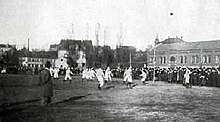
The first game of Bayern Munich against
Nuremberg in 1901
FC Bayern Munich was founded by members of a Munich gymnastics club (MTV 1879). When a congregation of members of MTV 1879 decided on 27 February 1900 that the footballers of the club would not be allowed to join the
German Football Association (DFB), eleven members of the football division left the congregation and on the same evening founded Fußball-Club Bayern München. Within a few months Bayern achieved high-scoring victories against all local rivals and reached the semifinals of the 1900–01
South German championship.
[2] In the following years the club won some local trophies and in 1910–11 Bayern joined the newly founded "Kreisliga", the first regional Bavarian league. They won this league in its first year, but did not win it again until the beginning of World War I in 1914, which halted all football activities in Germany.
[3][12]
The advent of
Nazism put an abrupt end to Bayern's development. The president and the coach, both of whom were Jewish, left the country. Many others in the club were also purged. Bayern was taunted as the "Jew's club" and as a semi-professional club Bayern was also affected by the ruling that football players had to be full amateurs again. In the following years Bayern could not sustain its role of contender for the national title, achieving mid-table results in its regional league instead.
[14]
After the war Bayern became a member of the
Oberliga Süd, the southern conference of the German first division, which was split five ways at that time. Bayern struggled, hiring and firing 13 coaches between 1945 and 1963. In 1955 they were relegated, but returned to the
Oberliga in the following season and won the
DFB-Pokal for the first time, beating
Fortuna Düsseldorf 1–0 in the
final.
[15][16] The club struggled financially though, verging on bankruptcy at the end of the 1950s. Manufacturer Roland Endler provided the necessary funds and was rewarded with four years at the helm of the club.
[17] In 1963 the Oberligas in Germany were consolidated into one national league, the
Bundesliga. Five teams from the Oberliga South were admitted. Bayern finished third in that year's southern division, but another Munich team,
TSV 1860 München, had won the championship. As the DFB preferred not to include two teams from one city, Bayern was not chosen for the Bundesliga.
[4] They gained promotion two years later, fielding a team with young talents like
Franz Beckenbauer,
Gerd Müller, and
Sepp Maier — who would later be collectively referred to as
the axis.
[16]
Udo Lattek took charge in 1970. After winning the
cup in his first season, Lattek led Bayern to their third German championship. The deciding match in the
1971–72 season against
Schalke 04 was the first match in the new
Olympic Stadium, and was also the first live televised match in Bundesliga history. Bayern beat Schalke 5–1 and thus claimed the title, also setting several records, including points gained and goals scored.
[19] Bayern also won the next two championships, but the zenith was their triumph in the
European Cup finalagainst
Atlético Madrid, which Bayern won 4–0 after a replay.
[20] During the following years the team was unsuccessful domestically, but defended their European title by defeating
Leeds United in the
1975 European Cup Final when Roth and Müller secured victory with late goals. "We came back into the game and scored two lucky goals, so in the end we were the winners but we were very, very lucky", stated
Franz Beckenbauer.
Billy Bremnerbelieved the French referee was "very suspicious." Leeds fans then rioted in Paris and were banned from European Football for three years.
[21] A year later in
Glasgow,
AS Saint-Étienne were
defeated by another Roth goal and Bayern became the third club to win the trophy in three consecutive years. The final trophy won by Bayern in this era was the
Intercontinental Cup, in which they defeated Brazilian club
Cruzeiro over two legs.
[22] The rest of the decade was a time of change and saw no further titles for Bayern. In 1977 Franz Beckenbauer left for
New York Cosmos and in 1979 Sepp Maier and
Uli Hoeneß retired while Gerd Müller joined the
Fort Lauderdale Strikers.
[23] Bayerndusel was coined during this period as an expression of either contempt or envy about the sometimes narrow and last-minute wins against other teams.
From FC Breitnigge to FC Hollywood (1979–98)[edit source | editbeta]

Executive board chairman
Karl-Heinz Rummenigge is the second highest goal scorer in Bayern Munich history and won multiple trophies in the 1980s.
The 1980s were a period of off-field turmoil for Bayern, with many changes in personnel and financial problems. On the field,
Paul Breitner and
Karl-Heinz Rummenigge, termed
FC Breitnigge, led the team to Bundesliga titles in
1980 and
1981. Apart from a DFB-Pokal win in
1982, two relatively unsuccessful seasons followed, after which Breitner retired and former coach Udo Lattek returned. Bayern won the
1984 cup, then went on to win five championships in six seasons, including a
double in 1986. However, European success was elusive during the decade; Bayern managed to claim the runners-up spot in the European Cup in
1982 and
1987.
[24]
Jupp Heynckes was hired as coach in 1987, but after two consecutive championships in
1988–89and
1989–90 Bayern's form dipped. After a second place in
1990–91 the club finished just five points above the relegation places in
1991–92. In the season of 1993–94, Bayern Munich lost out in the
UEFA Cup 2nd round to the
Premier League team
Norwich City, who remain the only English football club to beat them at their former home ground the
Olympic Stadium. Success returned when Franz Beckenbauer took over for the second half of the
1993–94 season, winning the Championship again after a four-year gap. Beckenbauer was then appointed club president.
[25]
His successors as coach,
Giovanni Trapattoni and
Otto Rehhagel both finished trophyless after a season, not meeting the club's high expectations.
[26] During this time Bayern's players frequently appeared in the gossip pages of the press rather than the sports pages, resulting in the nickname
FC Hollywood.
[27] Franz Beckenbauer briefly returned at the end of the
1995–96 season as caretaker coach and led his team to victory in the
1995–96 UEFA Cup, beating
Bordeaux in the
final. For the
1996–97 season
Giovanni Trapattoni returned to win the championship. But in the following
season Bayern lost the title to the just promoted
Kaiserslautern and Trapattoni had to take his leave for the second time.
[28]
Renewed international success (1998–present)[edit source | editbeta]
After his success at
Borussia Dortmund, Bayern were coached by
Ottmar Hitzfeld from 1998 to 2004. In Hitzfeld's first season, Bayern won the
Bundesliga and came close to winning the
Champions League, losing 2–1 to
Manchester United in injury time after leading for most of the
match. The 1999–2000 season resulted in Bayern winning their third
league and
cup double. A third consecutive Bundesliga title followed in
2001, won in a finish on the final day of the league season. Days later, Bayern won the
Champions League for the fourth time after a 25-year gap, defeating
Valencia CF on
penalties. The
2001–02 season began with a win in the
International Cup, but ended trophyless otherwise. A season later Bayern won their fourth double, leading the league by a record margin.
[29] Hitzfeld's reign ended in 2004, with Bayern underperforming, including a cup defeat by second division
Alemannia Aachen.
Felix Magath took over and led Bayern to two consecutive
doubles. Prior to the start of the
2005–06 season, Bayern moved from the Olympic Stadium to the new
Allianz Arena, which the club shares with
TSV 1860 München. On the field their performance in
2006–07was erratic. Trailing in the league and having lost to Alemannia Aachen in the cup yet again, coach Magath was sacked shortly after the winter break.
[30]
On 11 January 2008
Jürgen Klinsmann was named as Hitzfeld's successor, taking charge on 1 July 2008. He signed a two-year contract.
[33] Bayern Munich lost the
DFL-Supercup 1–2 against
Borussia Dortmund in 2008.
Bayer Leverkusen eliminated Bayern in quarter-finals of the
DFB-Pokal. In the
Champions League Bayern also reached the quarter-finals after winning Group F and defeating
Sporting Clube de Portugal in the first knockout round, achieving a Champions League record aggregate of 12–1. On 27 April, two days after a home defeat against
Schalke which saw Bayern drop to the third place in the table, Klinsmann was fired. Former trainer
Jupp Heynckes was named as caretaker until the end of the season.
[34] Bayern eventually finished second, thus qualifying directly for the Champions League in 2009–10.
The history of Bayern Munich kits
In the original club constitution, Bayern's colours were named as white and blue, but the club played in white shirts with black shorts until 1905, when Bayern joined MSC. MSC decreed that the footballers would have to play in red shorts. Also the younger players were called red-shorts, which was meant as an insult.
[2]Bayern has played in red and white for most of its existence, but blue has been included on occasion. In the 1968–69 season the shirts were striped in blue and red, and the shorts and socks were also blue. Bayern also wore red and blue stripes between 1995 and 1997, and in 1997 blue was the dominant colour for the first time when Adidas released an all
navy blue home kit with a red chest band. In 1999 Bayern returned to a predominantly red kit, which featured blue sleeves, and in 2000 the club released a traditional all red kit with white trim to be worn for Champions League matches.
[5]
The club's away kit has had a wide range of colours over the years, including white, black, blue, and gold-green. Bayern also features a distinct international kit. In 2009, the home kit was red, the away kit was dark blue, and the international kit was white.
[50] For the 2010–11 season, Bayern had a red and white striped home jersey, white away shirts with dark blue away shorts, and all-dark blue for international (Champions League) matches. For the 2012–13 season, Bayern had red and gold home jerseys, with white and orange away jerseys.
In the 1980s and 1990s, Bayern used a special away kit when playing at
1. FC Kaiserslautern, representing the
Brazilian colours blue and yellow, a
superstition borne from the fact that the club found it hard to win there.
[51]
Bayern's crest has changed several times. Originally it consisted of the stylised letters F, C, B, M, which were woven into one symbol. The original crest was blue. The colours of
Bavaria were included for the first time in 1954.
[5]
The modern version of the crest has evolved from the 1954 version in several steps.
[5] While the crest consisted of a single colour only for most of the time, namely blue or red, the current (2008) crest is blue, red, and white. It has the colours of Bavaria in its centre and FC Bayern München is written in white on a red ring enclosing the Bavarian colours.
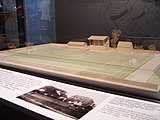
Model of Bayern's first stadium, their home from 1906 to 1924
Bayern played its first training games at the Schyrenplatz in the centre of
Munich. The first official games were held on the
Theresienwiese. In 1901 Bayern moved to its first own field, which was located in
Schwabing at the Clemensstraße. After joining the Münchner Sport-Club (MSC) in 1906, Bayern moved in May 1907 to MSC's ground at the Leopoldstraße.
[52] As the crowds gathering for Bayern's home games increased at the beginning of the 1920s, Bayern had to switch to various premises in Munich.
[53]
From 1925 Bayern shared the
Grünwalder Stadion with
1860 Munich.
[54] Until World War II the stadium was owned by 1860 Munich, and is still colloquially known as
Sechz'ger ("Sixties") Stadium nowadays. It was destroyed during the war, and efforts to rebuild it resulted in a patchwork. Bayern's record crowd at the Grünwalder Stadion is reported as more than 50,000 in the home game against
1. FC Nuremberg in the 1961–62 season.
[55] In the
Bundesliga era the stadium had a maximum capacity of 44,000 which was reached on several occasions, but the capacity has since been reduced to 21,272. As was the case at most of this period's stadiums, the vast majority of the stadium was given over to terracing. Today the second teams of both clubs play in the stadium.
[56][57]
For the
1972 Summer Olympics the city of Munich built the
Olympic Stadium. The stadium, renowned for its architecture,
[58] was inaugurated in the last Bundesliga match of the
1971–72season. The match drew a capacity crowd of 79,000, a total which was reached again on numerous occasions. The stadium was, in its early days, considered to be one of the foremost stadia in the world and played host to numerous major finals, such as that of
1974 FIFA World Cup.
[59] In the following years the stadium underwent several modifications, such as an increase in seating space from approximately 50% to ca. 66%. Eventually the stadium had a capacity of 63,000 for national matches, and 59,000 for international occasions such as European Cup competitions. Many people, however, began to feel that the stadium was too cold in winter, with half the audience exposed to the weather due to lack of cover. A further complaint was the distance between the spectators and the pitch, the stadium betraying its track and field heritage. Modification of the stadium proved impossible as the architect
Günther Behnisch vetoed major modifications of the stadium.
[60]
After much discussion the city, the state of
Bavaria, FC Bayern, and
TSV 1860 jointly decided at the end of 2000 to build a new stadium. While Bayern had wanted to build a purpose-built football stadium for several years, the awarding of the
2006 FIFA World Cup to Germany stimulated the discussion as the Olympic Stadium no longer met the
FIFA criteria to host a World Cup game. Located on the northern outskirts of Munich the
Allianz Arena has been in use since the beginning of the
2005–06season.
[60] Its initial capacity of 66,000 fully covered seats has since been increased for matches on national level to 69,901 by transforming 3,000 seats to terracing in a 2:1 ratio.
[61] Since August 2012 2,000 more seats were added in the last row of the top tier increasing the capacity to 71,000
[62]
The most prominent feature of the stadium is the translucent outer layer, which can be illuminated in different colours for impressive effects. Usually red lighting is used for Bayern home games, blue for 1860 home games and white for
German national team home games.
[63]
In May 2012, Bayern opened a museum about its history, FC Bayern Erlebniswelt, inside the Allianz Arena.
[64]